Railway Accounts Department Examinations

Showing posts with label traffic accounts. Show all posts

Wednesday, April 15, 2026

CATP - Cargo Aggregator Transportation Product - Traffic Accounts


CATP - Cargo Aggregator Transportation Product

Source: Rates Circular 03 of 2024 CATP

CATP stands for Cargo Aggregator Transportation Product (supersedes Freight Forwarder Scheme)

RC Rates Circular No.: 03/2024 Effective from: 15.03.2024

Objective: Cargo aggregation + wider commodity basket

Excluded Commodities: Coal, Ores, Iron/Steel, Slag

Minimum Lead: 300 km

Permitted Wagons: Covered wagons (BCN, BCNA, BCNAHS, BCNHL)

Mini Rake: Minimum 20 wagons

Floor Rate: ≥ NTR of Class LR-1

CG Registration: Mandatory in eRD

Security Deposit: ₹1 lakh (non-refundable)

Validity: Division-wise

Indenting Authority: Only CG can place indent

CG Role:


• Aggregates cargo
• Places indent
• Coordinates consignors/consignees
• Responsible for loading & unloading

Freight Liability:


• Consignor/consignee primary
• CG responsible in case of default

Forwarding Note:


• Can be single initially
• Full details later at loading

Commodity Change: Up to 20% wagons allowed

RR Type: Prepaid, “Said to Contain”

Multiple RR: Allowed

Concession: Only 6% for NER traffic

Misdeclaration:

• >2 commodities → Class 200
• Others → normal rules

Freight Basis: Wagon-wise, trainload class


Key points for MCQ

  1. CG registration is division-specific

  2. No prior Railway approval needed for customer list

  3. Floor rate cannot go below LR-1 

  4. CG: Cargo Aggregator

  5. eRD: electronic Registration of Demand module

  6. RR: Railway Receipt

  7. NTR: Normal Tariff Rate

  8. NER: North Eastern Region


Monday, August 4, 2025

NTR - Normal Tariff Rate - Traffic Accounts


NTR stands for Normal Tariff Rate (in Traffic)

NTR refers to the total charges for transport of a commodity inclusive of:  

The Base Freight Rate as published in the goods tariff  

Plus Demand Management Charges like busy season surcharges. 

Plus Congestion Charge (if any) 

Plus supplementary charges as applicable on various transportation products.


Tuesday, July 29, 2025

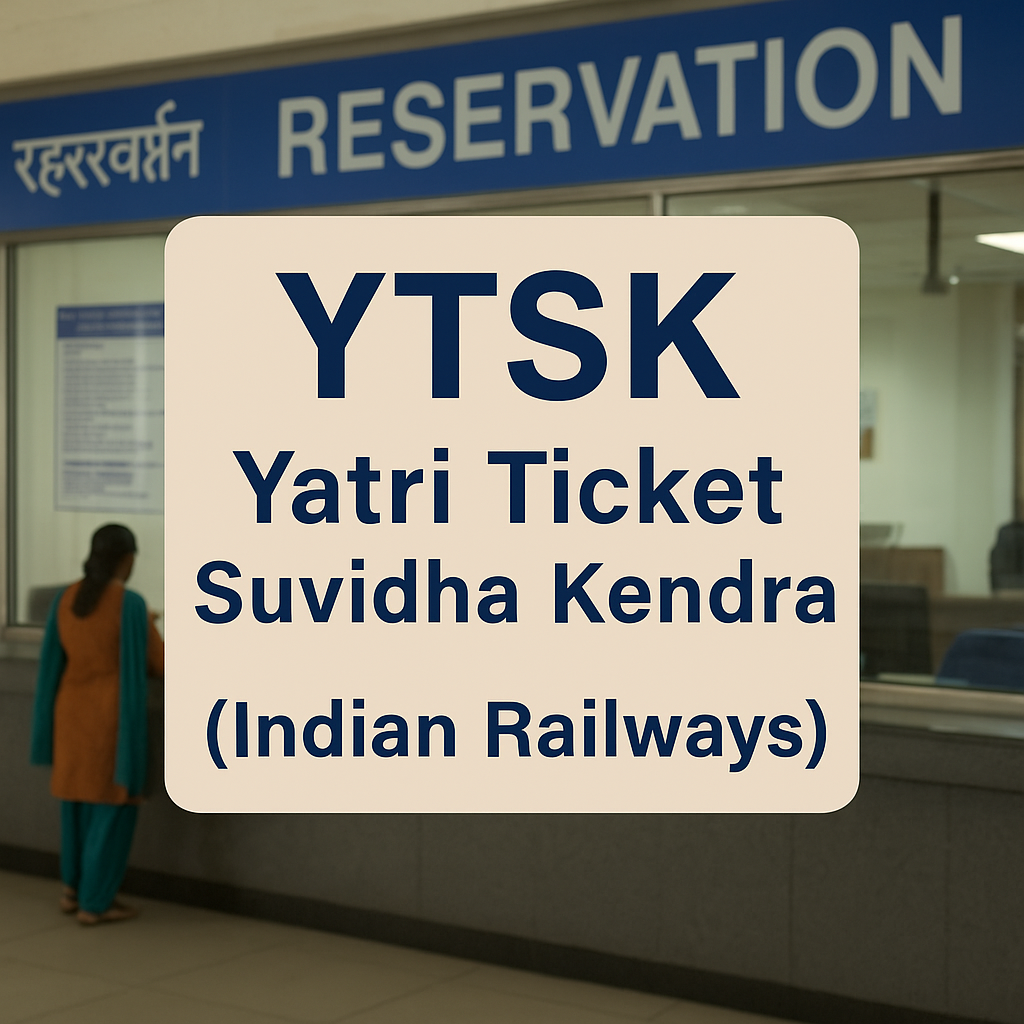
YTSK - Yatri Ticket Suvidha Kendra


YTSK - Yatri Ticket Suvidha Kendra


  • Private ticket booking counters authorized by Indian Railways to issue reserved and unreserved tickets through the PRS (Passenger Reservation System).

🔹 Key Features:

  • Purpose: To expand ticketing facilities through authorized private agents beyond railway premises.

  • Operated by: Registered individuals/firms/companies approved by zonal railways.


💰 Financial Requirements:


Particular

Amount

Registration Fee

₹2 lakh (one-time, non-refundable)

System Access Charges

₹1.6 lakh per terminal per annum

Security Deposit

₹1 lakh per terminal (up to ₹5 lakh max)

Revenue Sharing

25% of service charge to YTSK

Service Charges

₹30 (SL/2S), ₹40 (AC classes) per ticket

📆Other Key points:

  • Tenure: 3 years (renewable)

  • Maximum Terminals per Licensee: 4 (can be increased based on need)

  • Working Hours: Generally 08:00 AM to 10:00 PM 

  • Ticket Rolls: Supplied free by Railways (distinct color)

  •  Counter Setup: Must be outside railway premises

  • Training: Mandatory for operators

✅ YTSK: Success & Impact on Indian Railways


1. Convenient & Decentralized Ticketing

YTSKs provide PRS (reserved) and UTS (unreserved) ticketing outside station premises, reducing crowding and queue pressure at railway counters.  Ideal for passengers who are not internet-savvy or want to avoid station congestion.

2. Enhanced Passenger Reach

Serves localities and urban/rural areas away from stations, making ticketing more accessible and widespread

3. Balanced System Load

Helps decongest PRS counters, especially in peak periods, while complementing IRCTC website bookings (which already account for 70%+ of reservations) 

4. Private Partnerships with Accountability

Operated under strict licensing and monitoring to prevent misuse—Railways can disable terminals immediately if malpractices occur 

Advantages: 

  • 🕒 Extended Hours: YTSK counters often operate longer than traditional PRS counters (e.g., 8:30 am–10 pm vs. 8 am–8 pm)

  • 🎟️ Inclusive Access: Serves passengers without internet access or those unfamiliar with online booking.

  • 💼 Public–Private Model: Enables more centers via PPP, increasing availability of booking counters even beyond station premises.

Disadvantages:


  • 💰 Higher Charges: YTSKs levy service charges (₹30 for Sleeper/2S, ₹40 for AC), which are higher than standard PRS counters

  • 🎯 Tatkal Disadvantage: Tatkal bookings open later than railway counters or IRCTC, leading to disadvantage during high-demand periods

  • 💸 High Entry Barriers: Aspiring licensees must meet financial commitments—₹1.6 L system access per terminal, ₹2–5 L deposit, and ₹2–5 L registration fee depending on circulars and modifications.

  • 🧾 Limitations on Service: Cannot issue concession tickets (except for senior citizens), no block booking, and limited cancellation ability (I

🚆 Final Word

YTSKs have helped decongest station counters, extended ticket booking hours, and brought railway ticketing closer to communities. They serve as a reliable option for users outside major stations, especially those uncomfortable with online booking. However, they come with higher charges, operational conditions, and limitations compared to direct PRS or IRCTC booking methods.

Key Points Summary: 

  1. YTSK stands for Yatri Ticket Suvidha Kendra

  2. Registration Fees : Rs. 2 Lakhs (One Time, Non Refundable)

  3. System Access Charges Rs. 1.6 Lakhs per Terminal per Annum

  4. Security Deposit: Rs. 1 Lakh per Terminal (up to Rs. Lakh maximum)

  5. Revenue sharing: 25% of Service charge to YTSK

  6. Service Charges Rs. 30 per Ticket (Non AC), Rs. 40 Per Ticket (AC)

  7. Tenure: 3 Years 

  8. Working hours: 8 AM to 10 PM


End


Tuesday, May 20, 2025

Fly Ash / Bed Ash Loading - Freight Incentive schemes


Fly Ash / Bed Ash Loading 

Introduction and Background

The Railway Board has introduced a revised Freight Incentive Scheme specifically targeting the loading of Fly Ash and Bed Ash. 

Authority: CC No. 09 & 95 of 2020 and CC No. 219 of 2024 

Objective: 

The core objective of this scheme is to encourage additional loading of Fly Ash and Bed Ash and to enhance the utilization of rolling stock by offering targeted freight incentives.

                                            Fly Ash / Bed Ash Loading - Discount 

Type of Rolling Stock

Rate of Concession

Packing condition

Open Wagons

40% Discount on NTR of applicable classes

Bagged or Bulk or loose

Flat Wagons

40% Discount on NTR of applicable classes

Bagged only

Covered Wagons

To be charged at NTR of Class LR 1

Bagged only


Applicability Conditions


The 40% discount is applicable only when the entire rake is released, unloaded, emptied, and then back loaded at the same terminal. 

If empty rakes are supplied from other terminals, the discount is limited to 20% only.

Floor Rate Policy

There will be no floor rate for concessions under this scheme. The applicable chargeable freight will reflect the full discount of 40% or 20% on the NTR of the respective class.

Permitted Terminals

The scheme is applicable to all terminals, ensuring wide coverage and implementation flexibility.

Concurrent Concession

The following can be availed simultaneously:
- Freight concessions for traffic moving to/from the North East Region.

- In case of traffic booked in the TEFD (Traditional Empty Flow Directions) stream, the lower of the two NTRs will be charged.

Lead Restriction

There will be no restriction on the lead distance, giving flexibility to shippers.

Processing Procedure

Customers need not apply separately to avail these concessions. The benefit will be automatically granted via TMS (Terminal Management System), depending on the features of the scheme.

Key points for MCQ - Loading of Fly Ash / Bed Ash:

  1. In Open Wagons - 40% discount on NTR - Packing condition is bulk or loose or bagged 

  2. In Flat Wagons - 40% discount on NTR - Packing condition is Bagged only 

  3. In covered Wagons - charged at class NTR of LR 1 - Packing condition is Bagged only 

  4. NTR stands for Normal Tariff Rate

  5. Applicable for all terminals

  6. Discount is limited to 20%, if empty rakes are supplied from other terminals

  7. No lead restriction

  8. Concurrent concession available for freight to and from for North East region

  9. In case of TEFD, the lower of two NTRs will be charged

  10. TEFD stands for Traditional Empty Flow Direction

  11. TMS stands for Terminal Management System

===end===